Owens, George Washington (Dairying coursework, summer school, 1899)

George Washington Owens, the son of formerly enslaved farmers, was born 21 January 1875, near Alma, Kansas (Owens, 2022). He became the first African American graduate of Kansas State Agricultural College (later Kansas state University) in June 1899. In early 1899, Owens had accepted a position at Tuskegee Institute (now Tuskegee University). For a salary of $48 a month plus board, Owens was to be in charge of the creamery and act as the assistant to Iowa State College alumnus Prof. G. W. Carver. In order to prepare for this position, Owens did additional coursework at Iowa State. Owens recounted his short time at ISC in his autobiography, saying, “Later in August 1899 I spent 2 or 3 weeks in the creamery at the Iowa State College at Ames Iowa to take special work in butter making, cheese making and dairy management and organization before going to Tuskegee Inst, Tuskegee Ala to teach” (Owens, 2022).

On 21 August 1901, Owens married Waddie Logan Hill, a graduate of Clark University in Atlanta, Georgia. The couple had four children, one of whom, Anne Elnora, became a graduate of Iowa State’s M.S. program in Home Economics. Waddie Owens passed away in 1921 following a long struggle with her health after contracting Spanish Influenza (Owens). George married his second wife, Pearl, in 1924.

George Owens worked at Tuskegee with Prof. Carver until taking a job at Virginia Normal and Industrial Institute (later Virginia State University) in 1908 as a professor of agriculture. “Owens became a prominent leader in the development of agricultural education in secondary schools and colleges throughout the South. He played a leading role in founding the New Farmers of Virginia in 1927, and he was credited with writing the original constitution and bylaws of the organization.” (Owens, 2022). After 24 years serving Virginia State College, the state of Virginia, and the farmers of the South, Owens was recognized by the school, which named the agricultural building in his honor. Thirty-one years later and 18 years after his retirement as chair of the department of Agriculture, when a new School of Agriculture building was constructed in 1963, Owens’ name was moved to that building. George Washington Owens died 9 May 1950 in Richmond, VA.

SOURCE:

Owens, G.W. (2022). Autobiography of George Washington Owens: First

African American graduate of Kansas State University (A.R. Crawford, Ed.). Center for the Advancement of Digital Scholarship, Kansas State University. https://kstatelibraries.pressbooks.pub/owensproject/. (Original work written 1945)
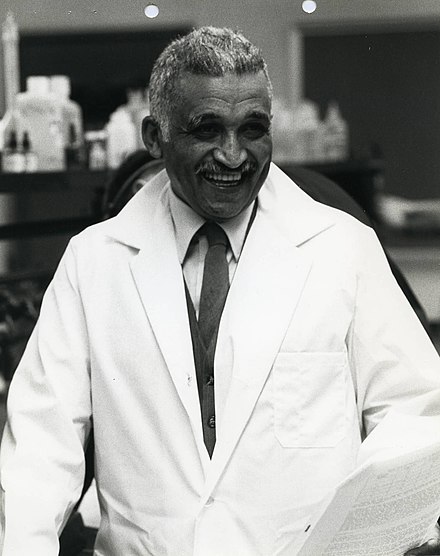
Massie, Samuel Proctor Jr. (PhD, Organic Chemistry, 1946)

Photo of Samuel P Massie in a lab.

Samuel Proctor Massie, Jr., was born in Argenta, AR, 3 July 1919, to Earlee Lillian Jacko Massie, a teacher, and her husband Samuel Proctor Massie, Sr., charter member of Phi Beta Sigma Fraternity and AME minister in North Little Rock, who also taught at Dunbar High School there.

Massie Jr graduated from Dunbar High School at the age of 13 after following his teacher mother from class to class, and then worked at a grocery store to earn tuition fees for studying at Dunbar Junior College in Little Rock. He graduated summa cum laude with a Bachelor of Science in Chemistry in 1937 at the age of 18, from the Arkansas Agricultural, Mechanical, and Normal College.

Massie gained a master’s degree in Chemistry from Fisk University in Tennessee in 1940 on a scholarship, then taught for a year at Arkansas AM&N before going on to study for his PhD at Iowa State University in 1941 and would later complete it in 1946.

In the second year of his doctoral studies in 1943, his father died from an asthma attack. Massie worked in the Ames Laboratory, researching the conversion of uranium isotopes into liquid compounds that could be used in the atomic bomb. He worked on the Manhattan Project from 1943 to 1945. In those intervening years you can read more about Massie’s work on the Manhattan Project from the Ames Research Laboratory.

In 1947, Massie married Gloria Bell Thompkins, who he met after the War when he was teaching at Fisk University. The Massies’ had three sons. They lived in Laurel, Maryland, when he joined the U.S. Naval Academy.

After completing his PhD and teaching for a time at Fisk University, Massie joined the faculty of Langston University in Oklahoma, where he taught from 1947 to 1953. He became the first African-American president of the Oklahoma Academy of Science. In 1953, he returned to Fisk University, where he taught until 1960. In 1954, he published a paper, The Chemistry of Phenothiazine.

In 1960, Massie moved to Washington, D.C., taking on the role of Associate Program Director for Special Projects in Science Education at the National Science Foundation, helping improve college laboratories nationwide.   He was also a professor at Howard University. In 1963, he became the third President of North Carolina College at Durham.

Massie was appointed to the faculty of the United States Naval Academy by President Johnson in 1966, its first African-American professor. During his tenure in Annapolis, Massie served on the academy’s equal employment opportunity committee and helped establish a black studies program. He retired from the post in 1993. Massie subsequently became the vice president of Bingwa Software Company, developing multicultural educational software.  In 1984, he and others were granted a patent for a chemical compound to treat gonorrhea, malaria, and bacterial infections.  In 1994, the U.S. Department of Energy created the Dr. Samuel P. Massie Chair of Excellence, a $14.7 million grant to nine historically black colleges and one for Hispanic students to further environmental research. His portrait was hung in the National Academy of Sciences Gallery in 1995.  In 1998, he was voted by the readers of Chemical and Engineering News as one of the top 75 distinguished contributors to chemistry in history.

His wife died on January 22, 2005, and Massie, who had dementia, died soon after, on April 10, 2005, aged 85. He also self-published a short autobiography with the collaboration of Robert C. Hayden in 2005.

Sources

Photo Credit: US Naval Academy(N.D.)  Samuel P Massie in a lab. Wikimedia Commons. https://commons.wikimedia.org/wiki/File:Samuel_P_Massie_in_lab.jpg

“Ames Laboratory History Profile: Samuel P. Massie.” Ames Laboratory, 8 Feb. 2021, www.ameslab.gov/news/ames-laboratory-history-profile-samuel-p-massie.

“Samuel P. Massie.” Wikipedia, Wikimedia Foundation, 30 Jan. 2024, en.wikipedia.org/wiki/Samuel_P._Massie.

McDew, Mary Leona Bradley (B.S., Family and Consumer Sciences, 1945)

Mary Leona Bradley, born on the Rose farm, East Vaolinia Township, Cass County, MI, on 23 August 1923, was the fourth child of William Bradley and his wife Frieda Moxley. Mary graduated from high school in South Bend, IN, in 1941, entered the University of Michigan in 1943, later transferring to Iowa State College (“Mary Leona McDew,” 2007). While at Iowa State, Mary was one of several Black Students not allowed to live in the Home Management House as part of the Family and Consumer Sciences (FCS) degree program (Ross, 1997).

Shortly after attaining her FCS Bachelor’s Degree in 1945, Mary began teaching at Georgia State College for Colored youth (Now Savannah State University). Her marriage to Dr. Stephen M. McDew occurred in December of that year. The couple had two daughters. (“Mary Leona McDew,” 2007).

Mary Bradley McDew died 21 March 2007 in Savannah, GA. (“Mary Leona McDew,” 2007).

Sources

Mary Leona Mcdew. (2007, 22 March). Legacy. Accessed 22 February 2024. https://www.legacy.com/us/obituaries/legacyremembers/mary-mcdew-obituary?id=29357250

Ross, Ann. (1997, 22 April). Personal communication to Farwell T. Brown. Ames History Museum Collection.

css.php