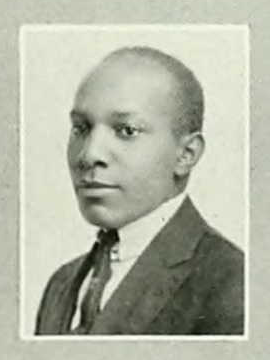
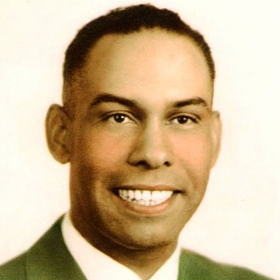
Charles Lee Brantley was born 25 Nov 1891 in Jackson, Mississippi, to Mack Brantley, a formerly enslaved and Esibell Londie Dickson Brantley. Charles served as a Private in Company H of the 806th Pioneer Infantry in 1919. Not long before his enlistment, he married Nevada Doris Lewis Brantley on 18 August 1918; however, at the time of his draft registration in 1917, he claimed he already had a wife and child to support. The couple divorced in 1931. In 1926, Charles attended Iowa State College. During that time he resided at 200 ½ Main Street. Charles Lee Brantley died on 3 March 1966 and was buried in Detroit Memorial Park.
Atwood, Rufus Ballard (B.S., Agricultural Education, 1923)
Rufus Ballard Atwood was born 15 March 1897, in Hickman, Kentucky, one of seven children of Rufus “Pomp” Atwood, day laborer, and Annie Parker Atwood, who took in washing.
Atwood started his academic career at Fisk University in Nashville and, while still a student there, enlisted in the army to serve in France during WWI. He received a Bronze Star for bravery before returning to Fisk to complete his A.B. degree. In order to pursue more advanced education than Fisk was able to provide at that time, Atwood enrolled at Iowa State and graduated with his B.S. in Agricultural Education in 1923. During his time at Iowa State, he was active in the Ag Club and Vocational Education Club, as well as the Alpha-Nu Chapter of Alpha Phi Alpha, belonging alongside Iowa State brothers John “Jack” Trice, Jesse Otis, Frederick Patterson, Lawrence Potts, John Lockett, James Fraser, and Aubrey Aldridge. He married Mabel Edith Campbell on 28 June 1921 in Petersburg, Virginia, while he was still a student at Iowa State.
Following his graduation from ISC, Atwood embarked on a distinguished career as a leader at two HBCUs. In 1923, he was hired as a Professor of Agriculture at Prairie View State Normal & Industrial College (now Prairie View A&M University), in Prairie View, Texas. By 1926, he was Director of the Agricultural Department, and one of four Iowa State graduates among the department’s seven professors. His colleagues included Edward Evans, Lawrence Potts, and John Lockett, with Joseph Alexander soon to acquire his M.S. and become the fifth ISC graduate on the faculty.
He later became Acting President of the institution. In 1929, Atwood moved from Prairie View to become the ninth and longest-serving president of Kentucky State Industrial College for Colored Persons (now Kentucky State University), holding the office from 1929 to 1962. While there, Atwood was recognized for his dedication to quality education and his inspirational leadership, which transformed the school into an accredited four-year college. For his work, he received the Sullivan Medallion in 1962, the first African American to receive the University of Kentucky’s highest honor.
Rufus Atwood died, aged 83, on 18 March 1983 in Cincinnati, Ohio. He is buried in Frankfort Cemetery, Frankfort, Kentucky.
Sources
- Photo Credit: Iowa State University. (1923). Rufus Ballard Atwood [Photograph]. 1923 bomb, 130. Retrieved from https://n2t.net/ark:/87292/w9ch0w
Bibb, Cornelius Connant (B.S., Electrical Engineering, 1925)
Cornelius Connant “Cal” Bibb was born in Alton, IL, in 30 Dec 1900, one of six children born to Scott Nathaniel Bibb, born into slavery in Missouri, and Minnie L. Stokes Bibb, who had been married 23 March 1882. In 1908, when Cornelius was seven, Bibb’s father won a long-fought battle for Black children to be admitted with White children to schools in Alton, IL. The case had been in the courts since 1897, before Cornelius was born, gaining extensive national news coverage for Bibb’s family. Scott Bibb died in 1909, leaving Minnie a widow. By 1915, the family had moved to Ottumwa, IA, where Cornelius could enroll alongside White students and graduate from Ottumwa High School.
During his time at ISC, he lived for a number of semesters in what residents called “The Interstate Club,” an apartment at 226 1/2 Main Street in the Elliott Building. His marriage to Beatrice Jennie Campbell occurred in New York City on 12 May 1941. He was employed by the New York Transit System Power Division and as a machine operator in a refining company. Bibb, a Methodist, died 18 November 1959 in The Bronx, NY. He is buried in Ferncliff Cemetery and Mausoleum, Hartsdale, New York.
Sources
Photo Credit: Iowa State University. (1925). Cornelius C. Bibb. [Photograph]. 1925 Bomb, p. 47. Retrieved from https://n2t.net/ark:/87292/w9n04q
Banning, James Herman (left ISC in 1924)
James Herman Banning, known as “Herman,” was born on 5 November 1899, in Canton, Oklahoma Territory, the last of four children born to Riley W. Banning, a farmer, and his wife Cora Woods Banning. After moving to Ames in 1919 to attend ISC, he studied Electrical Engineering. Like many of his Black college classmates, Banning worked while attending school and after leaving ISC in 1924 to pursue his dream of becoming a pilot; he operated the J. H. Banning Auto Repair Shop from 1922 to 1928. After catching the flying “bug” in 1920, Banning took flying lessons in Des Moines. He became “the first Black aviator to receive a federal pilot’s license and the first Black pilot to complete a transcontinental flight across the U.S.” (Ames History Museum).
During his time in college, Banning also lived for a number of semesters in what residents called “The Interstate Club,” an apartment at 226 1/2 Main Street in the Elliott Building. While living there, he met fellow Interstate Club resident Frederick D. Patterson (D.V.M. 1923, M.S. 1927). Patterson later wrote about seeing Banning fly when he lived in Iowa, the first time Patterson had seen a Black aviator. This inspiration, along with the likes of Black Aviator Bessie Coleman and others, encouraged Patterson to see the potential for a commercial aviation program at Tuskegee Institute (now Tuskegee University), where he became president in 1935. This was the program that produced the famed Tuskegee Airmen of WWII.
Banning left Iowa in 1929 to take a job in Los Angeles, CA, teaching other African American would-be pilots as chief instructor at the newly opened Bessie Coleman Aero Club aviation school. While there he also purchased his biplane, christened “Miss Ames.” A few years later, from 18 September to 9 October 1932, Banning and co-pilot Thomas Cox Allen, completed a coast-to-coast flight from Los Angeles to New York City that secured for these so-called “Flying Hobos” the distinction of being the first African Americans to complete a transcontinental flight. (Moore).
Only a few months later, on 5 February 1933, Banning died in an air crash (aged 33), during an air show in San Diego, CA. As the biography of Banning on the Oklahoma Historical Society website notes, “Because of his color, this experienced pilot was not allowed to fly the plane in the air show. Instead, he had been only a passenger in a plane piloted by an aviation machinist mate second class from the San Diego Naval Air Station” (Moore). Banning is buried in Evergreen Cemetery, Los Angeles, CA.
In fall 2022, the Ames City Council renamed the Ames Municipal Airport the James Herman Banning Ames Municipal Airport in recognition of Banning’s contributions to aviation history and his ties to the Ames community.
Photo courtesy of Philip Hart, University of Massachusetts, Farwell T. Brown Photographic Archive, Ames Public Library.
Sources
Ames History Museum. “Know History. Build a Better Future,” Ames History Museum, https://ameshistory.org/content/know-history-build-better-future.
Moore, Bill. “Banning, James Herman,” The Encyclopedia of Oklahoma History and Culture, https://www.okhistory.org/publications/enc/entry.php?entry=BA042.
Aldridge, Aubrey Cooper (B.S., Animal Husbandry, 1923)
Aubrey Cooper Aldridge was born in Prairie View, Texas, on 20 January 1902, to H. C. Aldridge and Ida Cooper Aldridge. During his time at ISC, he lived for a number of semesters in what residents called “The Interstate Club,” an apartment at 226 ½ Main Street in the Elliott Building. Other residents of the apartment in the early 1920s included J. Herman Banning, Frederick Patterson, Rufus Atwood, Cornelius Bibb, Compton Chapman, James Fraser, John Lockett, Jesse Otis, Lawrence Potts, Clarence Smith, Malcolm Stubblefield, and John Sweatt. While living there, Aldridge lent his baritone voice to a musical group of Interstate Club residents that sang at local events in the early 1920s (“Ames Items”). During his time at ISC, he was also recorder for the Alpha-Nu Chapter of Alpha Phi Alpha in 1923, belonging alongside Iowa State brothers John “Jack” Trice, Jesse Otis, Frederick Patterson, Lawrence Potts, John Lockett, James Fraser, and Rufus Atwood (Aldridge, 1923).
After graduation, Aldridge went on to get his teaching certificate at the University of Southern California and Master’s of Science at Arizona State College. Aldridge married Robinez Erma Robinson in Los Angeles, California, in 1927 and they had a daughter, Betty Jean, in 1928. In 1943 he married Winstona Hackett, daughter of prominent Phoenix parents (her father was the first African American doctor in Arizona), in Phoenix, Arizona. They had one son, Aubrey Cooper Aldridge, Jr.
Aldridge, Sr., taught at Dunbar Elementary and then became Principal there. Later in his career, he became Principal at Mary McLeod Bethune Elementary, working there until his retirement in 1967. He passed away in Phoenix, Arizona, 23 June 1995.
Sources
Photo credit: Aubrey Aldridge [Photo]. (n.d.) Ancestry. Retrieved from https://www.ancestry.com/mediaui-viewer/tree/10312558/person/-653532351/media/5d900701-5bcf-4e2e-adec-c6aef308f761
Aldridge, A. C. (1923, June). “Alpha Nu Chapter State College of Iowa, Des Moines, Iowa.” The Sphinx, 9.3, p. 17. https://issuu.com/apa1906network/docs/192300903
Ames items. (1920, January 30). The Iowa state bystander. Library of Congress, Chronicling America: Historic American Newspapers Site. Retrieved from https://chroniclingamerica.loc.gov/lccn/sn85049804/1920-01-30/ed-1/seq-4/