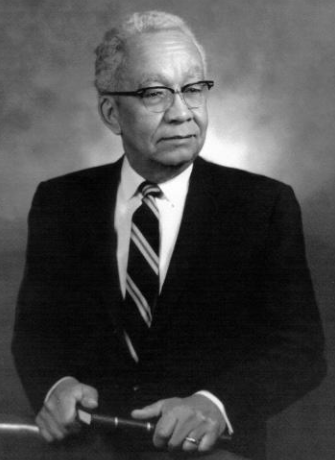
Calloway, Nathaniel Oglesby (B.S., Chemistry, 1930; Ph.D., Chemistry, 1933)

Headshot of Nathaniel Oglesby Calloway

Nathaniel Ogelsby Calloway was born in Tuskegee, Alabama, on 10 October 1907, as one of the five children of James N. Calloway and Marietta (aka Mary E., aka Mamie) Oglesby Calloway. His father had been enslaved when young but had gone on to receive a college degree. Calloway began his studies at Iowa State College in 1926, working toward a Bachelor’s of Science in Organic Chemistry, which he received in 1930. During those undergraduate years, he was a member of the ISC Debate Team. Following his B.S. he enrolled in the Organic Chemistry Ph.D. program at Iowa State, working with Dr. Henry Gilman. Calloway earned his Doctorate in Organic Chemistry in 1933, becoming the first African American to receive a Ph.D. in Chemistry from Iowa State. He maintained regular contact with Dr. Gilman via correspondence after completing his degree. Many of those letters are in the Gilman papers in Iowa State University Special Collections. While attending ISC, Calloway lived at 1204 3rd Street, the Walter G. Madison home; 218 Lincoln Way, the Archie and Nancy Martin House; and 2928 Wood Street, the home of ISC alumna Willa Juanita Ewing’s family, the Charles Anthonys.

Dr. Calloway married Henriette Mabel Fulton of Des Moines, Iowa, on 29 August 1933. After graduating, he became a chemistry professor and then Head of the Department of Chemistry at Tuskegee Institute from 1933 to 1935. According to a letter from fellow Iowa State alumnus A. C. Aldridge, Dr. Calloway was present at the inaugural event for Tuskegee’s new President, Frederick D. Patterson, ISC class of 1921 and 1927. In 1936, Dr. Calloway took up a position as an Assistant Professor of Chemistry at Fisk University which he held until 1940. In 1939, he started looking seriously for jobs in industry, because marital problems led to his position being difficult at Fisk with its strict Quaker administration (Calloway, 1939). Following his divorce from his first wife, Calloway married three more times, his last wife being the former Mary Ann Borucki (“Dr. Calloway Dead” 9). 

Calloway, seeing no opportunities for advancement at Fisk, left the university in 1940, taking up graduate coursework in the University of Chicago’s Pharmacology Department (Calloway, 1940). His work at the University of Chicago went well initially, though Calloway expressed frustration with how little chemistry was actually involved in Pharmacology. In 1941 he won a 2-quarter fellowship in Pharmacology, was able to be employed during the summer full-time to earn money, and then received an assistantship that allowed him to teach in Pharmacology the next school year (Calloway, 1941). By spring 1943, however, the racism present at the school had begun to chafe; he “ran into so much racial prejudice at Chicago University in regard to clinical facilities” that he decided to leave the school for one “more liberal in its attitude” (Calloway, 1943). He graduated with his M.D. from the University of Illinois Medical School in December 1943.

After that, Dr. Calloway went on to be an Assistant Professor of Medicine at the University of Illinois in the 1950s and early 1960s; Chief of Medical Service at the Tomah, Wisconsin, Veterans Administration Hospital from 1963-1966; and the Madison, Wisconsin, General Hospital, from 1966 until his death on 3 December 1979. When not engaged in medical work, Dr. Calloway was a leader in the African American community in Chicago and nationally. According to Notable Black American Scientists, “his role in reorganizing the Chicago chapter of the Urban League [as its President from 1955 to 1959]…helped transform it from an embarrassment for the national organization to one of its most successful chapters” (Krapp, 1998, p. 54). He later served as the National Director of the Urban League from 1959-1962. When he became a Lecturer in the Afro-American Studies Program at the University of Wisconsin–Madison in 1970, “his…teachings on genetics and race…helped debunk racist notions of white superiority” (Krapp, 1998, p. 54); Calloway argued that “Often what are called racial differences are social and economic differences” (Krapp, 1998, p. 55). Also in 1970, Iowa State University honored Dr. Calloway with a Distinguished Alumni Award. Unfortunately, Calloway’s life was not without controversy. He was ousted from his Urban League Directorship for distancing the organization from early 1960s’ activism, and later, being accused of over-prescribing dangerous drugs to his patients in Madison (Krapp, 1998).

Because of his family’s long association with Tuskegee University, Dr. Nathaniel Calloway is buried in the university cemetery.

Iowa State College dissertation title: Condensation reactions of furfural and its derivatives

Iowa State University Library permalink: https://doi.org/10.31274/rtd-180813-14731

Sources

Calloway, Nathaniel. (1939). Gilman letter, 5 January 1939, Henry Gilman Papers, Iowa State University Special Collections Department, RS 13/6/52, Box 8, folder 8/12.

Calloway, Nathaniel. (1940). Gilman letter, 9 October 1940, Henry Gilman Papers, Iowa State University Special Collections Department, RS 13/6/52, Box 8, folder 8/12.

Calloway, Nathaniel. (1941). Gilman letter, 13 August 1941. Henry Gilman Papers, Iowa State University Special Collections Department, RS 13/6/52, Box 8, folder 8/12.

Calloway, Nathaniel. (1943). Gilman letter, 15 June 1943. Henry Gilman Papers, Iowa State University Special Collections Department, RS 13/6/52, Box 8, folder 8/12.

Dr. Calloway dead at 72. (1979, December 13). Tuskegee News. p 9. Accessed 4 January 2022.  http://tkg.stparchive.com/Archive/TKG/TKG12131979P09.php  

Krapp, Kristine M., ed. (1998) Nathaniel Oglesby Calloway, in Notable Black American scientists, Gale/Cengage Learning. pp. 54-56.

Biography available at  HBCU Connections at Iowa State University :  Nathaniel O. Calloway    http://hbcuconnections.iastatedigital.org/Nathaniel_O._Calloway 

Photo Credit:  https://www.blackpast.org/african-american-history/calloway-nathaniel-oglesby-1907-1979/

Hardy, John Garrick  (M.S., Vocational Guidance, 1933)

Headshot of John Garrick Hardy

John Garrick Hardy was born 16 November 1909 in Baldwin County, Alabama, to John Hardy and Pinkie Sommerville Hardy. In 1933, shortly after John earned his Master’s degree in Vocational Guidance from Iowa State College after only nine months in the program, he began teaching at Alabama State Teachers College (now Alabama State University) in Montgomery, Alabama, the institution where he taught for forty-six years (“Archive Record,” n.d., para. 4). Prior to attending ISC, he had earned a Bachelor’s of Science degree from that same school. In 1935, Hardy joined other Iowa Staters at the banquet held by the Iowa State Alumni Association for Frederick D. Patterson’s inauguration as President of Tuskegee. Four years later, Hardy married Mildred Elizabeth Motley on 25 December 1939 in Autauga, Alabama.

In 1946, with a completed Ph.D. from the University of Wisconsin, Dr. Hardy became “the first Black in the State of Alabama, who graduated from an all Black Public State supported institution of higher learning, to receive a Master’s degree (Iowa State University) and a Ph.D. degree (University of Wisconsin)” (“Archive Record,” n.d., para. 4). In recognition of his long-time impact on Alabama State and its students, Dr. Hardy received an honorary Doctor of Laws degree in the spring of 1977 (“Archive Record,” n.d., para. 4).

He ended his career as the head of the Sociology Department at Alabama State. The John Garrick Hardy University Center at Alabama State is named for him. His life was marked by a strong record of community service and commitment to bettering the lives of others. Dr. John Garrick Hardy passed away on 9 November 1986. He is buried in the Remount Park Cemetery in Montgomery, Alabama.

Iowa State College Dissertation Title: A study of the vocational intentions of negro students in fourteen city high schools in Alabama, 1933 

Iowa State University Catalog Record:https://iowa-primo.hosted.exlibrisgroup.com/permalink/f/12tutg/01IASU_ALMA21201769240002756

Sources

Photo credit: Archive record: Dr. John Garrick Hardy Collection. (n.d.) Levi Watkins Learning Center. Alabama State University. Retrieved from  https://alasu.pastperfectonline.com/archive/6AA61ED5-D87C-4710-96C1-385424122018 

Archive record: Dr. John Garrick Hardy Collection. (n.d.) Levi Watkins Learning Center. Alabama State University. Retrieved from  https://alasu.pastperfectonline.com/archive/6AA61ED5-D87C-4710-96C1-385424122018

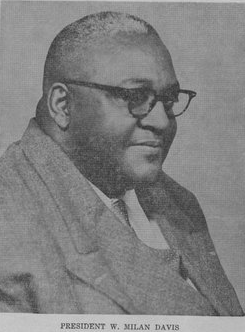
Davis, Walker Milan (M.S., Economics & Sociology, 1933)

Headshot of Walker Milan Davis

Walker Milan Davis was born in Okolona, Mississippi, 14 December 1908, the fifth son of Geroge Milan Davis and Leean (aka Leann) Johnson Davis, Mississippi farmers. In 1932, he graduated from Alcorn A & M College with a B.S. in Agriculture. A year later he earned an M.S. in Economics and Sociology from Iowa State College (1933). During his time at Iowa State, Davis resided at 1204 3rd Street (the home of Iowa State alumnus Walter G. Madison, Sr. (fall 1932), and at 208 ½ Main Street, (winter 1933). He also pursued Ph.D. coursework in Rural Sociology at the University of Wisconsin, never completing the degree.

Though the timeline for his employment is not clear, Davis seems to have held a series of temporary positions between 1933 and 1940 while also employed full-time at Okolona College as Dean and Registrar of the college. He worked for a semester in the Fisk University Social Science Department, a semester at Tuskegee Institute, for a time at Rust College, and for at least two semesters teaching sociology at his alma mater, Alcorn A & M College. Davis’s World War II draft card shows him employed in 1940 at the Ministerial Institute and College in West Point, Mississippi, where he held the position of business manager in 1942-43. That year, Davis took over the Presidency of Okolona College, a post that he held until his death in 1960 at age 51. He was buried in the college cemetery.

Iowa State College Dissertation Title: Alcorn College and its graduates : a case study in Negro leadership, 1933 

Iowa State University Catalog Record:https://iowa-primo.hosted.exlibrisgroup.com/permalink/f/12tutg/01IASU_ALMA21186415450002756

Sources

Photo Credit University of Okolona

Biography available at  HBCU Connections at Iowa State University :  Walker M. Davis  ( http://hbcuconnections.iastatedigital.org/Walker_M._Davis )

Dabney, Walter Hampton, Jr. (M.S., Highways,1933)

Headshot of Walter Hampton Dabney

Iowa State College Dissertation Title: Laboratory and road tests to determine some automotive characteristics used in highway design, 1933 

Iowa State University Catalog Record:https://iowa-primo.hosted.exlibrisgroup.com/permalink/f/12tutg/01IASU_ALMA21189687810002756

Sources

Biography available at  HBCU Connections at Iowa State University :  Walter H. Dabney  ( http://hbcuconnections.iastatedigital.org/Walter_H._Dabney )

Glass, Willie Lee Dorothy Campbell (M.S., Home Economics Education, 1933)

Headshot of Willie Lee Campbell Glass

Willie Lee Dorothy Campbell was born in Nacogdoches, Texas, on 24 August 1910, to Edward John Campbell, the principal of the local Black high school, and Mary Gertrude Kennedy Campbell, a teacher, in Nacogdoches. During her college years, Willie Lee was known by her maiden name, “Campbell,” but later in life, she became well known by her married name, “Glass.” Glass received her Bachelor of Science degree in 1931 in home economics from Prairie View Normal & Industrial College (now Prairie View A & M University) in Texas. She was a soror in the Gamma Omicron Omega Chapter of Alpha Kappa Alpha. Like most women of her time, Glass had little choice in fields of study. Home Economics was open to her and she chose to follow that path, coming to Iowa State College to complete her Master’s Degree in Home Economics Education.

Glass told the story of her arrival at ISC to researchers Rebecca W. Greer and Janice O. Kenner, who recount that Willie Lee, was dismayed by what she found when “arriving at Iowa State College, where she was not allowed to live on campus but had to reside with African  American  families  in  town” (Greer and Kenner, 2008, p. 141). Glass reported that “‘though  Black students  were  admitted  to  the  college,  most  of  them  were  sent  home  in  disgrace'” (Greer and Kenner, 2008, p. 141). She soon was writing home with the  following  message:  “‘The clouds  are  white;  the  ground  is  white;  and  all  the  people  are  white.  Can  I  come home?'” (quoted in Greer and Kenner, 2008, p. 141). Although her father was supportive of her returning home immediately, her mother wrote, “‘Look in the mirror and you will see another black face'” (quoted in Greer and Kenner, 2008, p. 141). And so, Glass continued her education at ISC, acquiring her Master’s Degree in 1933, when she was only 21 years old, making her one of the youngest students ever to graduate from ISC.

After graduation, she was employed as the head of the Department of Food and Nutrition at Virginia  State College, Petersburg, VA, in 1933, where she was named acting head of the Department of Home Economics in 1934. In the 1935-36 school year, she returned to Nacogdoches to teach home economics in the high school. On 27 August 1936, Willie Lee married Dominion Robert Glass, who served as president of Texas College from 1931 to 1961.

Glass established the Texas College Department of Home Economics and for 14 years, from 1936 through 1950, headed the department. She later became Texas Education Agency’s first Black state homemaking education consultant. During those years, from time to time, she taught White students at the local White school, Tyler Junior College, and in 1949 and 1950, taught summer classes as a visiting professor of home economics at Prairie View A&M College (Greer and Kenner, 2008). She even used her home as a classroom to teach students etiquette and table manners.

As a pioneer, Glass received many awards and recognitions. She was inducted into the Negro Hall of Fame by the city of Dallas, the Nacogdoches Heritage Festival Hall of Fame, and the Texas Future Homemakers of America Hall of Fame. In 1985, she was inducted into the Texas Hall of Fame by Mark White, the governor of the state (Greer and Kenner, 2008), and she was the first Black woman inducted into the Texas Women’s Hall of Fame. Further afield, the City of Los Angeles recognized  her with its Meritorious Community Service Award and she was named one of  11 Grande Dames of Texas by Texas Monthly Magazine (Greer and Kenner, 2008).

Glass received many awards and honors from the colleges she attended too. In 1961, she received the Distinguished Alumna Award from Prairie View A&M College, and in 1970, she received the Home Economics Alumni Centennial Award from Iowa State University. Beyond Iowa State, Glass further studied at Columbia University, Union Theological Seminary in New York, and the University of Wisconsin, Madison. In 1988, Glass received an honorary doctorate in humane letters by Texas College in 1988 and was placed in the Texas Women’s Hall of Fame in 1995 (Texas Senate Resolution 286, 1995). The home economics building at Texas College, the Willie Lee Glass Building, is named for her. 

Biography available at  HBCU Connections at Iowa State University :  Willie L. D. Campbell Glass 

Sources

Photo source:  HBCU Connections at Iowa State University :  Willie L. D. Campbell Glass 

Greer, R. W., and Kenner, J.O. (2008, December 1). Willie Lee Glass: A lady of remarkable influence. Family and consumer sciences research journal. 37.2. pp. 140-148.

css.php