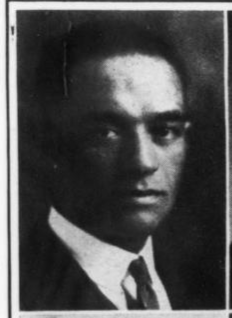
Thomasson, Maurice E. (B.S., Sociology, 1926)

Headshot of Maurice E Thomasson

Maurice Ethan Thomasson was born 5 May 1892 in Monticello, Arkansas, the son of James E. Thomasson, a shop owner, and Isabella Brooks Thomasson. After studying at Hampton Normal and Agricultural Institute, Maurice earned a Bachelor’s degree from Iowa State College in 1926. At that time, Thomasson was one of only 13 Black regular session students at ISC (“A Record,” 1926). He graduated along with classmates Compton Chapman, Benjamin Crutcher, and Willa Juanita Ewing.

followed by a Master’s degree in sociology from the University of Minnesota and a doctoral degree from Columbia University. Thomasson became a faculty member at Johnson C. Smith University, an HBCU in Charlotte, North Carolina, after earning his doctorate. In 1941, He took up his post at the Delaware State College for Colored Students (now Delaware State University).

Thomasson married La Verne Boyer on 4 June 1947, the year that his employing institution became known as Delaware State College. He and his wife taught sociology at the school, Delaware’s only HBCU, from the 1940s through the 1960s. After turmoil at the college surrounding student dissatisfaction regarding campus infrastructure that was unable to support the influx of World War II veterans on the G.I. Bill, Thomasson was appointed to serve as acting president of the college in 1949. He returned to his position as faculty head of sociology studies after the hiring of a new president in 1950 but was appointed a second time as acting president in mid-1951, the college wanting to tap him permanently for the role. Thomasson, however, turned down the offer, stating his desire to teach. (Holmes, 2014)

During this second term as Acting President, in 1952, Thomasson was called upon to testify at a landmark Delaware integration trial that considered consolidated court cases Gebhart v. Belton and Bulah v. Gebhart. Thomasson’s “sociological perspective” on segregated schools was recorded in the trial transcript:

 I don’t think that in a segregated situation it is possible to produce a person who is fully normal, completely satisfactory. There are some conditions inherent in the segregated situation that just simply warp a person’s personality. Now, for one thing a person who goes to school in a segregated school goes to that school by virtue of the fact that the State of which he is a part has said he is inferior. That is, the State has embodied that in the law, and the law has been sustained by the courts. He is told as he goes there the school segregated by law that he is inferior. (Holmes, 2014). 

Donald Evans, a former student of Thomasson’s, remembered his former professor’s demeanor as unsuited to being a president of a university: “He was a very nice man, but I don’t think he had the personality to be a (permanent) president of a University” (quoted in Holmes, 2014). For the rest of his academic career, Thomasson taught sociology before retiring from teaching in 1967.

He died on 8 September 1973 and was buried in Odd Fellows Cemetery in Smyrna, Delaware. Delaware State University’s Thomasson Hall and Maurice Thomasson Center are named after him.

Sources

Photo credit: A record of the Negro at college 1926. (1926, August). The crisis: A record of the darker races, p. 187.

A record of the Negro at college 1926. (1926, August). The crisis: A record of the darker races, p. 174.

Holmes, Carlos. (2014, Feb. 12). Dr. Maurice Thomasson carried on work during trying times, declined permanent president post. Delaware State University, Dept. of Human Ecology [Blog]. Accessed 12 Dec. 2021. [No longer available.]

Headshot of Maurice E. Thomasson

Romm, Harry J. (B.S., Zoology, 1930; M.S., Entomology, 1934; Ph.D. Plant Morphology, 1946)

Headshot of Harry J Romm

Harry J. Romm was born 4 Sept 1899 in Navasota, TX, to Benno Romm, born in Schwarzenau, Germany, and a mother from Tennessee.

Romm was still enrolled in public school at age 19 when he registered for the WWI draft in 1918, later graduating from Galveston Central High School, Galveston, Texas. In 1920, according to the Federal Census, Romm was employed as a porter in a dry goods store in Galveston. He married Fannie B. Dunlap in Dallas, Texas, on 11 June 1927 and was listed in 1928 Dallas City Directory as a teacher.

Moving to Ames in 1923, Romm earned his B.S. in Zoology in 1930, M.S. in Entomology in 1934. In 1935, Romm was an attendee at the banquet held by the Iowa State Alumni Association for Frederick D. Patterson’s inauguration as President of Tuskegee where he was listed as the Head of Department of Biology at Tuskegee Institute. While at Tuskegee, he served as a Volunteer Weather Collector for NOAA, a position that was held prior by George Washington Carver. During WWII, he served as a Principal Correspondent for the Army Specialist Corps.

Romm went on to earn his Ph.D. in Plant Morphology in 1946 and was later listed as teaching Biology at Southern University, Louisiana, in 1952. He died on 15 November 1955 and is buried in Lakeview Cemetery, Galveston, Texas. His headstone suggests he was a Catholic.

Iowa State College Dissertation Title: The development and structure of the vegetative and reproductive organs of kudzu, Pueraria thunbergiana (Sieb and Zucc) Benth; The insect depredators of purslane (Portulaca oleracea L.), 1946 

Iowa State University Catalog Record:https://quicksearch.lib.iastate.edu/permalink/01IASU_INST/q0r84t/cdi_proquest_journals_301851928 

Potts, Lawrence Alexander  (B.S., Agricultural Education, 1925)

Headshot of Alexander Lawrence Potts

Lawrence Alexander Potts earned his bachelor’s degree in Agricultural Education from ISC in 1925. While attending ISC, he was a member of the Alpha-Nu Chapter of Alpha Phi Alpha in 1923, belonging alongside Iowa State brothers J. G. Trice, J. R. Otis, F. D. Patterson, A.C. Aldridge, J. L. Lockett, J. W. Fraser, and R. B. Atwood (Aldridge, 1923). After graduation, he worked as an itinerant teacher trainer for the Agricultural Department at Prairie View Normal & Industrial College (now Prairie View A & M University) before later becoming the Director of Agriculture there.

Sources

Aldridge, A. C. (1923, June). “Alpha Nu Chapter State College of Iowa, Des Moines, Iowa.” The Sphinx, 9.3, p. 17.

Madison, Walter G. Jr.  (B.S., Engineering, 1940)

Walter Garfield Madison, Jr., was born in Ames, Iowa, on 3 November 1918, the first-born son of parents Walter Garfield Madison (ISC class of 1914), the first licensed Black plumber in the state, and his wife, Gussie Irene Askew Madison. Walter, Jr., graduated from Ames High School in 1936 and enrolled in the Engineering program at Iowa State College. During his time at ISC, he was a member of the Iowa State Players.

He lived at home with his family at 1204 Third Street. His parents housed many Black ISC students there until they moved to live year round in Nashville, Tennessee, in 1942. When he registered for the draft in 1940, Walter, Jr., was listed as self-employed by the W. G. Madison Company of Nashville, Tennessee, where he married Anita Smith. He died 22 August 1985, in Washington, D.C., after a career as an mechanical engineer.

Sources

Photo Credit: Iowa State University. (1938). The Bomb 1938. p. 118. Retrieved from  https://digitalcollections.lib.iastate.edu/islandora/object/isu:TheBomb_36547#page/192/mode/2up

Stewart, Katherine Glass (B.S., 1934, M.S., Child Development, 1948)

Headshot of Katherine Glass Stewart

Ms. Stewart completed her thesis, Differences between Fathers and Mothers in Knowledge of and Attitudes toward Child Behavior, in 1948 to earn her Master’s of Science degree at Iowa State in Child Development.

Iowa State College Dissertation Title: Differences between fathers and mothers in knowledge of and attitudes toward child behavior, 1948

Iowa State University Catalog Record:https://quicksearch.lib.iastate.edu/permalink/01IASU_INST/174tg9m/alma990009337230102756 

css.php